Apartment Renovation in Rio de Janeiro — How I Managed a Complete Renovation from Germany
Why Should You Renovate an Apartment Before Listing on Airbnb?
A full apartment renovation before listing on Airbnb increases nightly rates by 25–40%, reduces maintenance costs, and eliminates guest complaints about outdated infrastructure — making it the highest-ROI investment for properties held longer than three years. This is the lesson I learned from renovating a 45m² apartment in Rio de Janeiro while living in Munich, Germany.
The apartment was presentable when I bought it for R$760,000. A previous owner had kept it in reasonable condition, and I could have furnished it and listed it within a few weeks. Most investors would have done exactly that.
My reasoning was different. I buy apartments to generate income for years, not months. A cosmetic refresh leaves the underlying structure unchanged — old electrical wiring, ageing plumbing, walls positioned for a different era of living. My renovation strategy is to start from zero: remove everything, install to my exact specification, and deliver a product that commands premium rates.
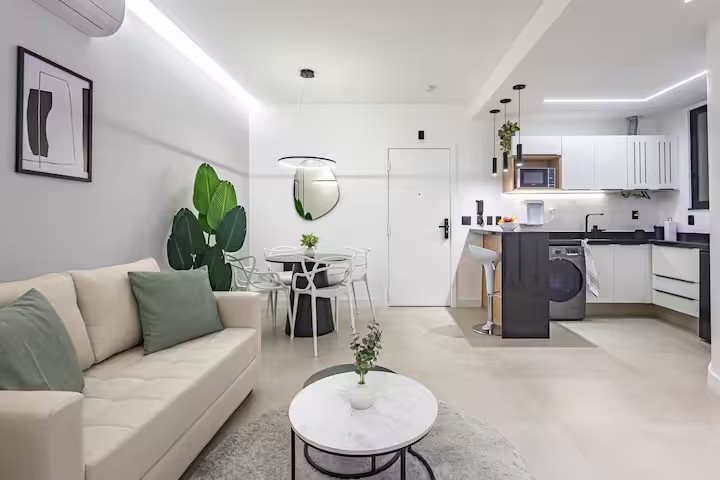
The renovation cost R$225,788 in labour and materials — approximately R$5,017 per square metre, which falls in the high-end range for Rio de Janeiro. The return is an apartment that commands higher nightly rates, requires virtually no maintenance in the first three years, and matches my brand standard across the portfolio.
"I bought without an estate agent. I renovated to my own standard. I manage from 9,000 kilometres away. That combination is the edge."
How Do You Manage a Renovation Remotely from Abroad?
Managing an apartment renovation remotely requires a structured team with specialist trades for each discipline, weekly video inspections, and detailed architectural drawings — replacing physical presence with documented accountability. Over 12,000 foreign property buyers acquired real estate in Rio de Janeiro in 2025 alone (SECOVI-RJ), many managing renovations from overseas.
The most common question I receive from foreign investors is: who do you trust to manage a renovation when you are not there? The answer is not one person — it is a structured team with specialist departments.
I have lived in Munich for 15 years. In Germany, if you specify something, it is done exactly that way — no discussion, no interpretation. Brazil operates differently. The culture is warmer, more flexible, more relationship-driven — which is a strength in many ways, but it means that as a client you need to stay engaged at every step. You cannot hand over a brief and disappear for a month.
The specialist team structure
My renovation team in Rio operates with dedicated specialists for each trade:
- Electrical — dedicated electrician who works to architectural drawings
- Plumbing — specialist team for all hydraulic and gas work
- Walls and ceilings — masonry and plastering specialists
- Flooring — tile and finishing team
- Painting — separate finishing crew
- Joinery and fitted furniture — custom cabinetry to specification
- Architecture — drawings produced before any work begins
This structure matters because it eliminates generalists. A single contractor who does everything tends to cut corners on the trades outside their core skill. Specialist teams are accountable for their domain only — and the quality shows.
Once I accepted that my involvement was not optional but essential, everything improved. Remote management does not mean absent management — it means disciplined, documented management from a distance.
What Does a Weekly Video Inspection Protocol Look Like?
A weekly video inspection protocol is a structured communication cycle where the site coordinator sends a video walkthrough, the owner reviews and responds with specific written instructions, and the team executes — creating a documented record of every decision throughout the renovation. This single practice is what makes remote renovation management possible.
Every week, my site coordinator sends me a video walkthrough of the work completed. This is non-negotiable. The video covers every room, every new installation, and every area where decisions need to be made.
After watching, I respond with specific instructions: approve what is correct, flag what needs adjustment, confirm material orders for the following week. This creates a documented record of every decision and prevents the most common renovation failure — work that drifts from the original specification because the owner was not paying attention.
Weekly video update → review from Munich → specific written instructions → team executes. Every week, without exception. If a week passes without a video, something is wrong.
What to look for in each video
- Progress against the architectural drawings — is the work matching the specification?
- Quality of finish — are edges clean, surfaces level, fixtures properly mounted?
- Material usage — are the correct tiles, fixtures, and fittings being installed?
- Potential problems — damp patches, structural cracks, misaligned work
- Decisions needed — material selections, positioning confirmations, change requests
The written instructions that follow the video are just as important as the video itself. They create an unambiguous paper trail. When a dispute arises three months later about whether you approved a particular tile layout, you have a timestamped message to reference.
Do You Need Architectural Drawings for an Apartment Renovation in Brazil?
Architectural drawings are essential for any major apartment renovation in Brazil — especially when managed remotely. Detailed floor plans that specify electrical outlet positions, plumbing entry points, and partition walls eliminate ambiguity and prevent costly rework. This is the single biggest lesson I have learned from managing renovations from abroad.
Before any work begins, we produce complete architectural drawings. These are not rough sketches — they are precise plans that specify:
- Position of every electrical outlet and light point
- Plumbing entry and exit points
- Wall positions and dimensions
- Ceiling heights and any structural changes
- Custom joinery dimensions and placement
When a renovation is managed remotely, these drawings eliminate ambiguity. There is no room for interpretation. The team follows the drawing — not their preference, not their habit, not what they think you probably want. The drawing is the instruction.
Every problem I have ever had traces back to a moment where the instruction was not precise enough. A drawing that says "electrical outlet here" without specifying the exact height, distance from the corner, and whether it is a single or double outlet will result in the electrician making a decision for you — and it may not be the decision you would have made.
What good architectural drawings include
For a remote renovation, the drawings must go beyond standard requirements. They should include: a complete electrical plan with outlet heights and types, a plumbing diagram with fixture positions, a lighting plan with switch locations, a joinery plan with dimensions to the millimetre, and a materials specification list tied to each area. The cost of thorough architectural planning is a fraction of the cost of rework.
How Long Does an Apartment Renovation in Rio de Janeiro Take?
A full gut renovation of a 40–50m² apartment in Rio de Janeiro typically takes 4 to 6 months, with building access restrictions, neighbour noise complaints, and material delivery delays being the primary factors that extend timelines. My 45m² renovation was planned for 4 months and took 5.
Plan your renovation timeline and add a 20–25% buffer. A 4-month plan becomes 5 months. A 6-month plan becomes 7–8 months. This is not pessimism — it is the reality of construction inside condominium buildings in Rio de Janeiro.
How Much Does It Cost to Renovate an Apartment in Rio de Janeiro?
A full gut renovation in Rio de Janeiro costs R$3,000–6,000 per square metre in 2026, depending on finish level and location. My 45m² apartment renovation cost R$225,788 in labour and materials alone — approximately R$5,017 per square metre — which falls in the high-end range (Planner5D Brasil, 2026).
Renovation cost per m² in Rio de Janeiro (2026)
| Finish Level | Cost per m² (R$) | 45m² Apartment | What's Included |
|---|---|---|---|
| Simple refresh | R$900–1,500 | R$40,500–67,500 | Paint, basic fixtures, cosmetic repairs |
| Medium renovation | R$1,600–3,000 | R$72,000–135,000 | New flooring, updated kitchen/bath, electrical |
| High-end gut renovation | R$3,000–6,000 | R$135,000–270,000 | Full strip-out, all trades, custom joinery |
Complete project cost breakdown
| Item | Cost (R$) | Notes |
|---|---|---|
| Apartment purchase price | R$760,000 | Purchased directly, no estate agent commission |
| ITBI transfer tax (~3%) | R$22,800 | Municipal property transfer tax |
| Notary & registration fees | R$8,800 | Escritura + Registro de Imóveis |
| Document translation & agent | R$1,000 | Sworn translation + despachante |
| Total acquisition cost | R$792,600 | +4.3% above purchase price |
| Full renovation (labour + materials) | R$225,788 | R$5,017/m² — high-end finish |
| Complete furnishing (Airbnb-ready) | R$51,711 | All furniture, appliances, linens, décor |
| Project management & consultancy | R$27,750 | End-to-end coordination and oversight |
| Total renovation + furnishing | R$305,249 | 40.2% of purchase price |
| Total project duration | 5 months construction + 2 weeks furnishing | |
| Total investment | R$1,097,849 | Generating Airbnb income since launch |
A note on buying without an estate agent: I purchased this apartment directly, without paying a corretor (estate agent) commission. In Brazil, buyer-side commissions are typically 3–6% of the purchase price. On a R$760,000 apartment, that represents R$22,800–45,600 saved. It requires more time and due diligence with professional guidance, but it is entirely legal and common in direct sale situations.
What Causes Renovation Delays in Brazil — and How Do You Avoid Them?
The four most common causes of renovation delays in Brazilian apartment buildings are condominium access restrictions, neighbour noise complaints, material delivery lead times, and seasonal weather — all manageable with a 20–25% timeline buffer and proactive planning.
1. Building restrictions on construction hours
Many condominium buildings in Rio restrict noisy work and heavy material movement to specific morning hours, typically 7am–12pm on weekdays. Material removal (rubble, waste) often has even tighter windows — my building allowed deliveries and removals only between 6am and 8am. When the lift was occupied or the building administrator was absent, the window closed entirely.
2. Neighbour complaints
In dense apartment buildings, noise complaints are common and should be expected. The building administration may impose work stoppages while disputes are resolved. My renovation had two separate neighbour complaints that caused a total of approximately 8 days of lost work time. This is normal in Rio condominium buildings.
3. Material delivery delays
Specialist materials — imported tiles, custom joinery components, specific fixtures — may have lead times of 2–4 weeks. Order materials at least one phase ahead of when they are needed. Do not wait until month 3 to order the flooring tiles that need to be installed in month 3.
4. Seasonal weather
Rio's wet season runs from November to March. While most apartment renovation work is interior, some aspects — window installation, balcony work, external waterproofing — can be affected. Schedule weather-sensitive work for the dry season (April–October) when possible.
Living in Germany for 15 years trains you to expect timelines to be met precisely. In Rio, external factors — building bureaucracy, neighbour relations, material supply chains — are less predictable. This is not a problem to be solved, it is a context to be managed. Patience is not optional.
What Does a Completed Airbnb Apartment Renovation Look Like?
A completed Airbnb apartment renovation delivers two measurable returns: higher nightly rates because the apartment looks and feels premium, and lower maintenance costs because every system is new — both compounding over time to justify the initial 4–6 month renovation investment.
When the renovation was complete, I flew to Rio for the final inspection. My team corrected every point I raised. I furnished the apartment, listed it on Airbnb as part of my growing portfolio, and it has been a success from the first booking.
The numbers that matter
- Higher nightly rates — a fully renovated apartment with modern finishes, new appliances, and quality furnishing commands 25–40% higher rates than a comparable unrenovated unit in the same building
- Lower maintenance — new electrical, plumbing, and fixtures mean virtually zero maintenance calls in the first 2–3 years
- Better reviews — guests notice quality. Consistent 5-star reviews drive higher occupancy and enable premium pricing
- Portfolio consistency — every apartment in my portfolio meets the same standard, which builds the brand
If you are buying in Rio de Janeiro and wondering whether to renovate or list as-is, my answer is straightforward: if you are planning to hold the property for more than three years, renovate. The compounding returns justify the investment.
Before buying, make sure you understand the complete tax structure for foreign Airbnb investors in Rio de Janeiro — including CNPJ, Simples Nacional, and cross-border obligations →
How Do You Choose a Renovation Contractor in Brazil as a Foreigner?
Choosing a renovation contractor in Brazil as a foreigner requires evaluating their team structure, requesting completed project references, insisting on a detailed written scope, and testing their willingness to work from architectural drawings and provide weekly video updates. The wrong contractor is the single biggest risk in a remote renovation project.
What to look for
- Specialist teams, not one person doing everything. A contractor who sends a dedicated electrician, a dedicated plumber, and a dedicated tiler delivers higher quality than one person attempting all trades. Ask who does what.
- At least three completed project references. Ask to see photos or visit completed apartments. Look for quality of finish in the details: edges, corners, grout lines, fixture alignment.
- A detailed written scope before work begins. The scope should itemise every trade, every material, and every deliverable. Vague scopes lead to disputes.
- Willingness to work from architectural drawings. A contractor who resists working from plans is a contractor who prefers to make decisions themselves. For remote management, this is unacceptable.
- Weekly video updates without resistance. If a contractor pushes back on sending weekly videos, they are not the right contractor for a remote project.
Red flags to watch for
- Requests for large upfront payments (more than 30% before work starts)
- No written contract or vague contract terms
- Resistance to providing references from previous clients
- Cannot or will not work from architectural drawings
- History of significant timeline overruns without valid reasons
- Uses the same person for multiple trades instead of specialists
I work with vetted specialist teams in Rio de Janeiro. If you are planning a renovation and want to avoid the trial-and-error process, learn about my renovation management service or message me directly on WhatsApp.
Official Resources — Renovation and Property in Rio de Janeiro
These official sources informed the cost data, regulations and market context referenced in this renovation case study.
- SECOVI-RJ — real estate market data and renovation cost benchmarks for Rio de Janeiro
- CREA-RJ — engineering and architecture licensing requirements for construction projects
- Receita Federal do Brasil — tax treatment and depreciation rules for renovation expenses
- Airbnb — Responsible Hosting in Brazil — listing requirements and hosting standards for renovated units
- A full gut renovation of a 45m² apartment in Rio costs R$3,000–6,000 per square metre depending on finish level — budget R$135,000–270,000 for a typical unit plus R$50,000+ for Airbnb-ready furnishing
- Remote renovation management works through three non-negotiables: specialist trade teams, weekly video inspections, and detailed architectural drawings that leave zero room for interpretation
- Plan your timeline with a 20–25% buffer — building access restrictions, neighbour complaints, and material delays are normal in Rio condominium buildings, not exceptions
- If you plan to hold the property for more than three years, renovate before listing — the compounding returns from higher nightly rates and lower maintenance justify the 4–6 month investment
- Choose a contractor who uses specialist teams, provides references, works from drawings, and sends weekly video updates without resistance — these four criteria filter out 80% of problems
Want to renovate in Rio the right way?
Download the free guide — or message me directly about your project. I answer every message personally.